When the Night Shift Held the Keys to Space: The Custodian Who Calculated America's Path to the Stars
The University After Dark
Every night at 11 PM, while the physics building at State University emptied of professors and graduate students, James "Jimmy" Rodriguez would unlock the custodial closet and begin his real work. Not the mopping and trash collection that paid his bills, but the intricate dance of numbers that had consumed his thoughts since he'd first glimpsed the discarded astronomy textbooks in a professor's wastebasket three years earlier.
Rodriguez had dropped out of high school at 16 to support his family after his father's injury at the steel mill. College was never even a distant dream—just keeping food on the table took everything he had. But the universe, it seemed, had other plans.
Finding Gold in the Garbage
It started with curiosity and a beat-up copy of "Fundamentals of Celestial Mechanics" that Professor Harrison had thrown away after updating his curriculum. Rodriguez couldn't resist flipping through it during his break. The equations looked like poetry to him—elegant, purposeful, describing the motion of planets and stars with mathematical precision.
Night after night, he'd study by the light of empty classrooms, teaching himself calculus from library books he'd check out during his lunch breaks. When he couldn't understand something, he'd carefully copy the equations onto scraps of paper and work through them at home, filling notebooks with his attempts to decode the language of orbital mechanics.
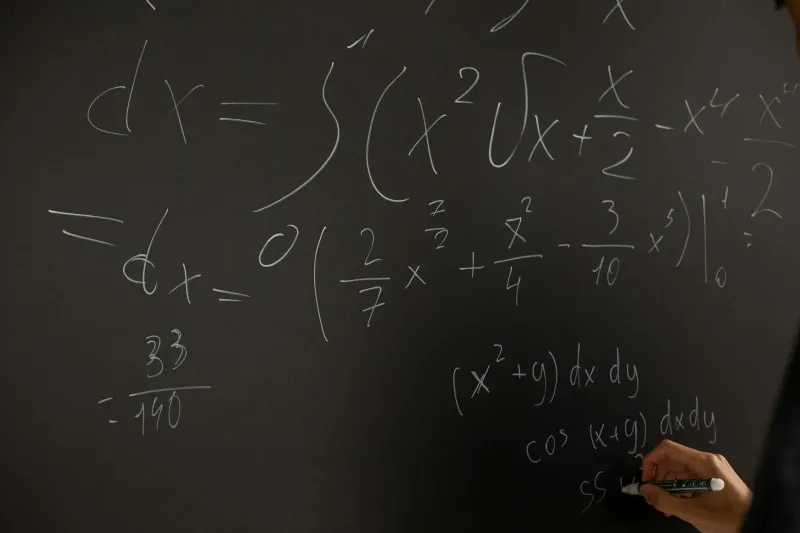
Professor Harrison first noticed something odd when he arrived early one morning to find complex trajectory calculations worked out on the blackboard in perfect detail. The janitor had not only solved the homework problem he'd assigned his graduate students—he'd found a more elegant solution.
The Midnight Mathematician
"I thought someone was playing a prank," Harrison later recalled. "The math was graduate-level work, but it was written in pencil on the back of cleaning supply invoices."
When Harrison finally caught Rodriguez in the act—hunched over a desk at 2 AM, surrounded by astronomy journals and working through satellite orbit equations—he didn't see a custodian who'd overstepped his bounds. He saw raw talent that the academic world had somehow missed.
Harrison began leaving progressively harder problems on the blackboards, and Rodriguez would solve them overnight, often finding shortcuts that impressed even the physics faculty. Word spread quietly through the department about their "midnight mathematician."
When NASA Came Calling
In 1957, as America scrambled to catch up in the space race after Sputnik's shocking success, NASA researchers were visiting universities across the country, looking for anyone who could help solve the complex problems of putting objects into stable orbit.
Dr. Katherine Wells arrived at State University expecting to recruit a few promising graduate students. Instead, she found herself in a late-night meeting with a 23-year-old janitor whose handwritten calculations for multi-stage rocket trajectories were more sophisticated than anything her team had produced.
"Jimmy didn't have the credentials, but he had something more valuable," Wells remembered decades later. "He had an intuitive understanding of orbital mechanics that you can't teach. He could see the geometry of space in ways that took our PhD mathematicians years to develop."
The Invisible Contributor
What happened next reveals both the best and worst of how America approached the space race. Rodriguez was quietly brought into NASA's trajectory planning team—not as a scientist or engineer, but as a "computational specialist." His official job title remained deliberately vague, and his name was kept off most official documents.
Working in a cramped office in the basement of NASA's Goddard Space Flight Center, Rodriguez spent the next eight years calculating the precise timing and positioning needed for America's early satellite launches. His work was critical to the success of Explorer 1, America's first satellite, and dozens of missions that followed.
But because he lacked formal credentials, his contributions were often attributed to the PhD scientists who supervised him. In meeting notes and mission reports, he appears only as "computational support" or "technical assistance."
The Price of Recognition
The irony wasn't lost on Rodriguez. "I was doing the same work as people with doctorates from MIT and Harvard," he said in a rare interview years later. "But I was the guy who mopped floors, so my name couldn't be on the papers that went to Congress or the press."
It wasn't malicious—his colleagues respected his abilities and fought for better recognition. But the institutional machinery of NASA in the 1950s and 60s wasn't built to acknowledge genius that came without the proper paperwork.
Rodriguez didn't seem bitter about it. "I got to help put satellites in space," he'd say with a shrug. "How many high school dropouts can say that?"
The Legacy in the Numbers
Today, Rodriguez's story is preserved mainly in the margins—handwritten notes in archived mission files, grateful mentions in colleagues' memoirs, and the precise orbital calculations that still bear the hallmarks of his elegant mathematical style.
He never became famous, never won awards, never got the recognition that his contributions deserved. But every time you use GPS, stream a video, or check the weather on your phone, you're benefiting from satellite technology that James Rodriguez helped make possible.
His story reminds us that genius doesn't always come with credentials, and that some of history's most important work happens in the shadows—done by people who never expected recognition, but who couldn't resist the pull of discovery.
Sometimes the most extraordinary achievements come from the most ordinary places. Sometimes all it takes is curiosity, determination, and access to a good blackboard at 2 AM.