History's Greatest Heists: When Credit Thieves Stole Scientific Glory
The Crime Scene of Scientific History
We love our scientific heroes. Einstein with his wild hair. Newton under his apple tree. Darwin on his voyage of discovery. These stories are comforting in their simplicity — lone geniuses having eureka moments that change the world.
But what if I told you that some of history's greatest scientific breakthroughs were basically elaborate heists? That behind many famous names lurk forgotten figures whose crucial contributions were systematically erased, stolen, or simply ignored?
Welcome to science's shadow history, where the real pioneers often didn't get the credit — and sometimes didn't even get their names in the footnotes.
The X-Ray Vision Thief
The Story You Know: Wilhelm Röntgen discovered X-rays in 1895, revolutionizing medicine and earning the first Nobel Prize in Physics.
The Story You Don't: Meet Bertha Röntgen, Wilhelm's wife and the world's first X-ray technician, radiologist, and patient advocate rolled into one.
When Wilhelm stumbled across mysterious rays emanating from his cathode ray tube, he was baffled. The rays could pass through solid objects but were blocked by metal. Intriguing, but how could he prove their medical potential?
Enter Bertha, who volunteered to be the first human X-ray subject. On November 8, 1895, she placed her hand on a photographic plate for 15 minutes while Wilhelm aimed his rays at her wedding ring. The resulting image — her skeletal hand with the ring floating around her finger bone — became the world's first medical X-ray.
But Bertha didn't stop there. She became Wilhelm's unofficial research partner, helping him understand how X-rays affected living tissue. She documented the side effects (including early radiation burns on her hands), suggested improvements to the exposure process, and even helped him write his initial papers.
When Wilhelm presented his discovery to the Würzburg Physical Society, Bertha sat in the audience, her damaged hands hidden in gloves. The applause was for Wilhelm alone. History remembers him as the X-ray pioneer. Bertha's contributions were relegated to a romantic footnote about a "supportive wife."
The kicker? Modern analysis of Wilhelm's lab notes reveals that many of the breakthrough insights about X-ray imaging came from Bertha's observations about how the rays affected her own body.
The Computer Code Conspiracy
The Story You Know: John von Neumann invented the stored-program computer concept that became the foundation for all modern computing.
The Story You Don't: A brilliant mathematician named Klára Dán von Neumann wrote the world's first computer programs and essentially invented software engineering — but was written out of computing history because she was "just" a wife helping her husband.
Klára was already an accomplished mathematician when she married John von Neumann in 1938. When John began working on early computer designs in the 1940s, Klára didn't just provide moral support — she became the world's first programmer.
Working on the ENIAC computer at Los Alamos, Klára wrote the code for the first computer simulations of nuclear reactions. She developed programming techniques that are still used today: subroutines, debugging methods, and optimization algorithms. She essentially created the field of scientific computing from scratch.
But here's where the heist happened: when papers were published about these groundbreaking computer programs, Klára was listed as a "research assistant" or sometimes not credited at all. The revolutionary programming concepts she developed were attributed to John and other male colleagues.
Klára's programming work was so advanced that when other scientists tried to replicate her nuclear simulations years later, they couldn't figure out how she'd made the calculations so efficient. Her code was decades ahead of its time, but since she wasn't considered a "real" computer scientist, her innovations were lost.
Today's programmers unknowingly use techniques that Klára pioneered, but most have never heard her name. She died in 1963, largely forgotten by the computing world she helped create.
The DNA Double-Cross
The Story You Know: James Watson and Francis Crick discovered the double-helix structure of DNA in 1953, earning them the Nobel Prize and eternal scientific fame.
The Story You Don't: Rosalind Franklin actually figured out DNA's structure first, but her male colleagues essentially stole her research and published it as their own discovery.
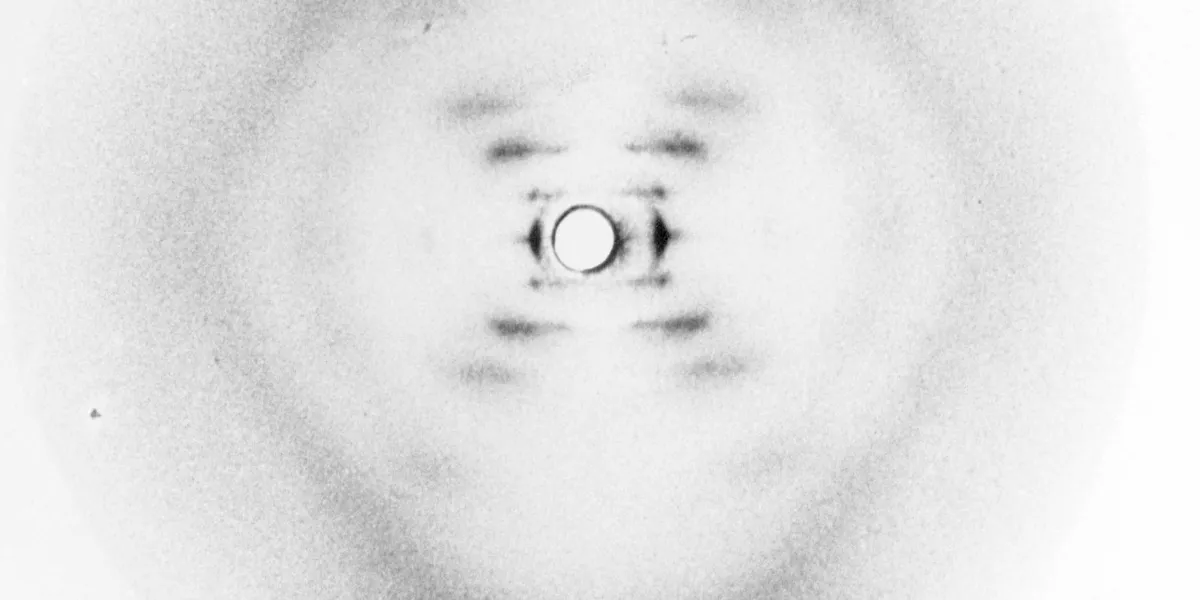 Photo: Rosalind Franklin, via res.cloudinary.com
Franklin was a brilliant X-ray crystallographer working at King's College London. Her meticulous experiments produced the clearest images of DNA structure ever captured, including the famous "Photo 51" that clearly showed DNA's helical structure.
Franklin's lab notebooks, discovered decades later, reveal that she had correctly identified DNA's double-helix structure, its dimensions, and the positioning of its chemical bases months before Watson and Crick published their "discovery."
So how did Watson and Crick beat her to publication? Through scientific espionage that would make Cold War spies proud.
Maurice Wilkins, Franklin's colleague, secretly showed Photo 51 to Watson without Franklin's knowledge or permission. Watson and Crick used Franklin's data to confirm their own model, then rushed to publish their findings. They acknowledged Franklin's "valuable contributions" in a footnote — the 1950s equivalent of thanking someone for their "input" after stealing their idea.
Franklin died of cancer in 1958, four years before Watson, Crick, and Wilkins won the Nobel Prize for "their" discovery of DNA structure. Nobel Prizes aren't awarded posthumously, so Franklin was doubly erased from history.
The most infuriating part? Watson's memoir, published decades later, portrayed Franklin as a difficult woman who didn't understand the significance of her own work. In reality, her lab notes show she understood DNA's structure better than any of her male colleagues.
The Radioactive Robbery
The Story You Know: Henri Becquerel discovered radioactivity in 1896, sharing the Nobel Prize with Pierre and Marie Curie.
 Photo: Marie Curie, via imgcdn.stablediffusionweb.com
The Story You Don't: Marie Curie actually discovered radioactivity as an atomic property, but Becquerel got credit because he stumbled across uranium's weird behavior first — even though he completely misunderstood what he'd found.
Becquerel's "discovery" was pure accident. He left some uranium salts on a photographic plate in a drawer and later found the plate had been exposed. He concluded that uranium emitted some kind of invisible light. End of investigation.
Marie Curie, working on her doctoral thesis, decided to study Becquerel's mysterious uranium rays. Through systematic experimentation, she made the real breakthrough: radioactivity wasn't unique to uranium. It was a property of atoms themselves.
Marie discovered that thorium was also radioactive, then identified two new radioactive elements: polonium and radium. She proved that radioactivity was an atomic property, not a molecular one — a distinction that laid the foundation for nuclear physics.
Most importantly, Marie developed the techniques and equipment that made radioactivity research possible. She invented methods for isolating radioactive elements, built the instruments needed to measure radiation, and established the scientific framework for understanding atomic decay.
But when Nobel Prize time came, the committee initially planned to honor only Becquerel and Pierre Curie. Marie was added almost as an afterthought, and only after Pierre threatened to refuse the prize unless his wife was included.
The historical irony is perfect: Becquerel accidentally stumbled across a phenomenon he didn't understand, while Marie systematically unraveled the secrets of the atom itself. Yet textbooks still credit Becquerel as the "discoverer" of radioactivity.
The Telescope Heist
The Story You Know: Galileo invented the telescope and used it to revolutionize astronomy, proving that Earth orbits the sun.
The Story You Don't: An unknown Dutch spectacle maker actually invented the telescope, while Galileo's astronomical breakthroughs built heavily on observations made by Thomas Harriot, an English mathematician whose discoveries predated Galileo's by months.
The telescope was invented around 1608 by Hans Lippershey, a Dutch lens grinder who probably stumbled across the principle while testing combinations of lenses. But Lippershey was a craftsman, not a scholar, so his invention was treated as an interesting toy rather than a scientific instrument.
Galileo heard about this "Dutch perspective glass" and quickly built an improved version. So far, so good — that's how innovation often works. But here's where the story gets murky.
Thomas Harriot, an English mathematician and astronomer, was also building telescopes and studying the heavens. His detailed drawings of the moon's surface, made in July 1609, clearly show lunar craters and mountains — the same features that made Galileo famous when he published similar observations months later.
Harriot's notebooks, discovered centuries later, reveal that he was systematically mapping the moon, observing Jupiter's moons, and tracking sunspots before Galileo published any of his telescopic observations. Harriot even made detailed studies of comets and developed mathematical models for planetary motion.
So why don't we celebrate Harriot as the father of telescopic astronomy? Because he never published his work. As a Protestant in Catholic-dominated Europe, Harriot worried that his observations supporting the Copernican system would bring unwanted attention from religious authorities.
Galileo, meanwhile, was a master of scientific publicity. He published quickly, wrote dramatically, and wasn't shy about claiming credit for discoveries. While Harriot quietly filled notebooks with groundbreaking observations, Galileo was becoming the face of the astronomical revolution.
The result? Galileo gets credit for "discovering" lunar craters, Jupiter's moons, and sunspots — phenomena that Harriot had already documented in detail.
The Pattern Behind the Heists
Notice the pattern? The forgotten figures in these stories share common traits: they were women, immigrants, working-class craftsmen, or simply people who lacked the social connections to claim credit for their work.
Meanwhile, the credit thieves were typically well-connected men who understood that scientific fame depends as much on publicity as discovery. They didn't necessarily set out to steal credit — they simply operated in a system that automatically assumed their contributions were more important.
This isn't ancient history. Similar dynamics still shape how scientific credit gets distributed today. The difference is that now we're more aware of these biases — which means we have the power to write more honest stories about how discovery really works.
Reclaiming the Narrative
These forgotten pioneers remind us that science is messier, more collaborative, and more human than our hero myths suggest. Real breakthroughs usually involve teams of people building on each other's work, not lone geniuses having sudden revelations.
Perhaps more importantly, these stories reveal how many brilliant minds we've lost to history simply because they didn't fit our narrow definition of what a scientist looks like.
The next time you hear about a famous discovery, ask yourself: whose name isn't in the story? Who did the unglamorous work that made the breakthrough possible? Who got written out of history because they didn't have the right credentials, connections, or chromosomes?
The answers might surprise you — and they'll definitely make you question everything else you think you know about how science really works.