The Hive Mind Discovery: How a Backyard Beekeeper Cracked Nature's Most Elusive Antibiotic
When Curiosity Meets the Unexpected
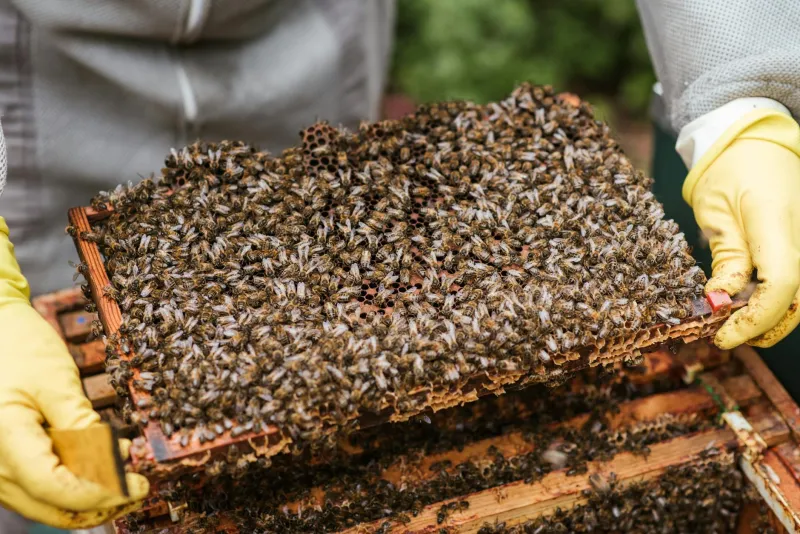
Karl Brennan was the kind of guy who talked to his bees. Not in a mystical way, but in the methodical manner of someone trying to solve a puzzle that had consumed fifteen years of his life. Every morning at 5:30 AM, he'd walk the rows of white wooden boxes behind his modest Denver home, notebook in hand, documenting everything from flight patterns to the subtle color variations in the wax.
His neighbors thought he was eccentric. The scientific community didn't think about him at all.
That changed in 2018 when Brennan's handwritten observations became the foundation for one of the most significant antimicrobial discoveries of the decade.
The Problem Everyone Else Missed
For over thirty years, biochemists had been chasing what they called the "hive paradox." Despite being packed with thousands of organisms in close quarters, beehives rarely succumbed to bacterial infections that should have wiped them out. Researchers knew bees produced propolis—a sticky substance used to seal their hives—but laboratory analysis kept coming up empty for any compounds powerful enough to explain this remarkable resistance.
The assumption was straightforward: if there was something there, sophisticated equipment would find it.
Brennan, a former auto mechanic turned full-time beekeeper, wasn't burdened by those assumptions. He didn't have a lab or a PhD. What he had was time, patience, and an almost obsessive attention to detail that fifteen years of keeping bees had only sharpened.
The Pattern in the Chaos
It started with what Brennan called his "sick hive." Colony 14B had been struggling for months—sluggish bees, irregular patterns, the kind of decline that usually meant the end. But instead of dying, something remarkable happened. The bees began producing an unusual amber-colored propolis, darker and stickier than anything Brennan had seen.
More importantly, the colony began to recover.
"I must have watched those bees for six hours a day," Brennan recalls. "My wife thought I'd lost my mind. But there was something different about how they were behaving, how they were building."
Brennan documented everything: temperature fluctuations, humidity levels, the specific flowers the bees visited, even the time of day they returned to the hive. Most crucially, he began collecting samples of the unusual propolis, storing them in his basement freezer with the same care a scientist might use for Nobel Prize-winning research.
The Breakthrough Nobody Saw Coming
The turning point came at a local beekeeping conference in Fort Collins. Dr. Sarah Chen, a microbiologist from Colorado State University, was giving a presentation on bee immunity when Brennan approached her afterward with a Ziploc bag full of his amber propolis samples.
"I almost didn't take him seriously," Chen admits. "But there was something about his detailed notes, the way he talked about the behavioral changes he'd observed. It was clear this wasn't just a hobbyist—this was someone who had been conducting real field research without realizing it."
Chen agreed to run preliminary tests on Brennan's samples. What she found changed everything.
The Compound That Shouldn't Exist
The unusual propolis contained a previously unknown compound—later named brennanin in honor of its discoverer—that showed remarkable antimicrobial properties against antibiotic-resistant bacteria. More surprisingly, the compound only formed under specific stress conditions that Brennan's "sick hive" had experienced.
"Karl had accidentally created the perfect laboratory conditions in his backyard," Chen explains. "The combination of environmental stressors, the specific plant sources his bees were visiting, and even the timing of collection—it was like he had reverse-engineered the exact circumstances needed to produce this compound."
Laboratory synthesis of brennanin is now being developed for medical applications, with early trials showing promise against MRSA and other drug-resistant infections.
The Outsider's Advantage
Brennan's discovery highlights something the scientific community is slowly learning to appreciate: sometimes the most important breakthroughs come from people who aren't trained to know what's impossible.
"I didn't know I wasn't supposed to be able to figure this out," Brennan says with a laugh. "I just knew my bees were trying to tell me something, and I had the time to listen."
Today, Brennan works as a consultant for three major pharmaceutical companies, his basement notes now digitized and studied by researchers around the world. He still keeps bees, still takes his morning walks with notebook in hand.
The difference is, now the scientific community is listening too.
Legacy of the Hive
Brennan's story reminds us that breakthrough discoveries often come from the most unexpected places. While researchers were looking through microscopes, he was watching bees. While they were testing compounds in sterile laboratories, he was collecting samples in his backyard.
Sometimes the biggest discoveries happen not because someone knows everything, but because they're curious enough to pay attention to what everyone else has overlooked.
In the end, Karl Brennan didn't just solve a scientific puzzle—he proved that the best laboratory is sometimes the one built by accident, tended by patience, and guided by the simple belief that nature still has secrets worth discovering.