The Night Sky Detective: How a Small-Town Librarian Beat Professional Astronomers at Their Own Game
The View From Nowhere
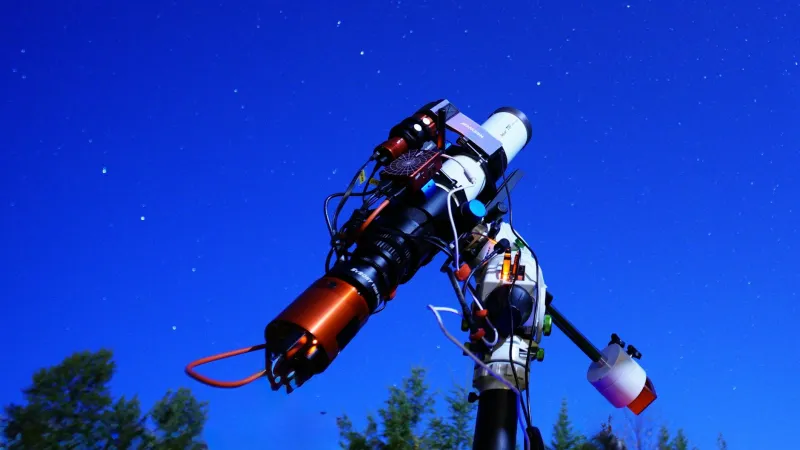
Every clear night for seven years, Margaret Chen climbed the narrow stairs to her apartment's flat roof in Millfield, Ohio, population 8,200. While her neighbors settled in for prime-time television, she adjusted the focus on her secondhand Celestron telescope—a retirement gift to herself when the public library's budget cuts forced her into early retirement at 58.
What started as a hobby to fill the quiet evening hours became something else entirely. Chen had no formal training in astronomy beyond a college physics course she'd taken thirty years earlier. She had no research grants, no access to million-dollar equipment, and no graduate students to help with observations. What she did have was time, curiosity, and the kind of methodical patience that comes from spending decades helping people find exactly the right book.
The Anomaly That Shouldn't Exist
On March 15, 2019, Chen noticed something odd about HD 164595, a star she'd been casually observing in the constellation Hercules. The star's brightness fluctuated in a pattern that didn't match anything in her amateur astronomy guides. Most stars that vary in brightness do so predictably—pulsing like cosmic heartbeats or dimming when planets pass in front of them.
This star was different. Its light curve looked like static on an old television, chaotic and seemingly random. Chen spent weeks double-checking her equipment, assuming the telescope was malfunctioning. She borrowed a friend's more expensive setup and got the same results.
"I figured I was doing something wrong," Chen later told Sky & Telescope magazine. "Who was I to think I'd found something that real astronomers had missed?"
But the data kept showing the same impossible pattern. After three months of observations, Chen did what any good librarian would do: she researched everything she could find about the star. What she discovered surprised her—professional astronomers had classified HD 164595 as unremarkable, a standard G-type star similar to our sun.
When Outsiders See What Experts Miss
Chen's breakthrough came from her lack of formal training. Professional astronomers typically focus their limited observation time on stars already known to be interesting. HD 164595 had been catalogued, measured, and filed away as ordinary. No one was watching it closely enough to notice its bizarre behavior.
Chen, however, had been systematically observing every visible star in a small patch of sky, treating each one as potentially fascinating. It was the astronomical equivalent of reading every book in a library section rather than just the bestsellers.
When she finally worked up the courage to contact Dr. Sarah Williamson at Case Western Reserve University, Chen expected polite dismissal. Instead, Williamson was intrigued. The data Chen had collected was more comprehensive than anything in the professional databases.
"Margaret had been observing this star almost nightly for months," Williamson explained. "We might look at a star like this once or twice a year, if at all. Her dataset was extraordinary."
The Discovery That Changed Everything
Williamson's team confirmed Chen's observations and made an even more startling discovery. The star's chaotic brightness variations weren't random—they contained a complex pattern that repeated every 847 days. HD 164595 was surrounded by a debris disk of unusual composition, creating interference patterns as material orbited the star at different speeds.
The finding challenged existing models of stellar evolution and debris disk formation. NASA's Kepler Space Telescope had observed the same star multiple times but had filtered out the variations as instrumental noise. The space agency's algorithms were designed to find regular, predictable patterns—not the complex chaos that Chen had patiently documented.
"Sometimes being an outsider is an advantage," said Dr. Michael Torres, who leads NASA's exoplanet discovery program. "We have sophisticated filters that help us process enormous amounts of data quickly. But those same filters can blind us to phenomena that don't fit our expectations."
The Citizen Science Revolution
Chen's discovery highlights a growing trend in astronomy. As professional researchers focus on increasingly specialized questions, amateur astronomers are filling crucial gaps in observation and data collection. The American Association of Variable Star Observers, founded in 1911, now includes thousands of citizen scientists whose contributions regularly appear in peer-reviewed journals.
Modern technology has democratized astronomy in ways unimaginable just decades ago. High-quality telescopes that once cost tens of thousands of dollars are now available for under $2,000. Digital cameras and computer software allow amateurs to collect and analyze data with precision that rivals professional equipment from the 1990s.
"The universe is vast, and there aren't enough professional astronomers to watch all of it," Chen noted. "There's room for everyone to contribute."
Beyond the Stars
Today, Chen splits her time between continued astronomical observations and mentoring other amateur astronomers through online forums and local astronomy clubs. She's co-authored three peer-reviewed papers and serves on the advisory board for the International Amateur-Professional Photoelectric Photometry consortium.
Her discovery of HD 164595's unusual behavior has led to follow-up studies by major observatories worldwide. The star system is now considered a prime target for future space-based telescopes that might reveal even more about its mysterious debris disk.
Chen's story reminds us that scientific discovery doesn't require institutional credentials or expensive equipment—just careful observation, persistent curiosity, and the willingness to trust what you see, even when it contradicts conventional wisdom. Sometimes the most important discoveries come not from those trained to look for specific things, but from those patient enough to notice what everyone else has overlooked.
In an age of big science and billion-dollar research programs, a retired librarian with a backyard telescope proved that the universe still has room for individual discovery. Her success suggests that the next great breakthrough might come not from a prestigious observatory, but from someone's rooftop, guided by nothing more than wonder and the discipline to keep looking up.