From the Fields to the OR: The Neurosurgeon Who Carried the Harvest in Her Hands
There's a photograph that Dr. Elena Vásquez keeps on her desk — not a diploma, not an award, not a photo from the day she finished her residency at Johns Hopkins. It's a faded snapshot of a girl, maybe nine years old, squinting into the California sun with dirt on her knees and a flat of strawberries balanced on her hip. Her mother is behind her, barely visible, working the same row.
Vásquez doesn't keep it there as a reminder of how far she's come. She keeps it there so patients can see it.
"I want them to know who I am before I open my mouth," she's said in interviews. "Not the credentials. Me."
Roots in the Row Crops
Elena Vásquez grew up following the harvest. Her parents arrived from Oaxaca, Mexico in the early 1980s, part of a wave of agricultural workers who filled the labor gap in California's farming counties. The family moved between Fresno, Salinas, and Stockton depending on the season — strawberries in spring, tomatoes in summer, almonds in the fall. Elena and her two brothers were expected to contribute from the time they could carry a bucket.
School was something that happened in between. She attended at least four different elementary schools before sixth grade, enrolling late each semester and withdrawing early. Teachers rarely learned her name before she was gone again. She fell behind in reading, ahead in math, and somewhere in the middle of all of it, developed a habit of asking questions nobody around her could answer.
Why do people's hands cramp in the cold? What happens inside someone's head when they get heat stroke? Her father, who had watched a coworker collapse in a field one August afternoon and never fully recover, couldn't tell her. Neither could anyone else.
So she started looking it up.
The Library That Changed Everything
The Fresno County library system doesn't get a lot of credit in the story of American medicine. It probably should.
At twelve, Vásquez discovered that the branch near their winter housing had a section on anatomy. She checked out every book they had. She read them in the evenings after fieldwork, sometimes by flashlight when the shared housing got too crowded and loud. By fourteen, she had a working understanding of the human nervous system that her high school biology teacher found, by her own account, "unsettling."
Her grades were inconsistent — hard to be consistent when you're perpetually the new kid — but her test scores, when she sat them, were extraordinary. A guidance counselor at her high school in Salinas, a woman named Mrs. Patricia Ochoa who Vásquez still credits publicly, saw something in those scores and pushed her toward a summer enrichment program at UC Davis. It was the first time Elena had ever been on a university campus. She was sixteen. She walked every building she was allowed into and stayed until they asked her to leave.
She applied to UC Davis two years later. She got in.
The Long Road Through Medicine
Getting in and staying in are different things, and Vásquez will tell you the second was harder. She worked throughout undergrad — cafeteria shifts, tutoring, a brief and deeply unglamorous stint cleaning research lab equipment at 5 a.m. She sent money home when she could. She graduated with honors in neuroscience and applied to medical school carrying debt, exhaustion, and a research paper on glial cell behavior that caught the attention of a professor who would later write her a recommendation letter he called "the most straightforward one I've ever written."
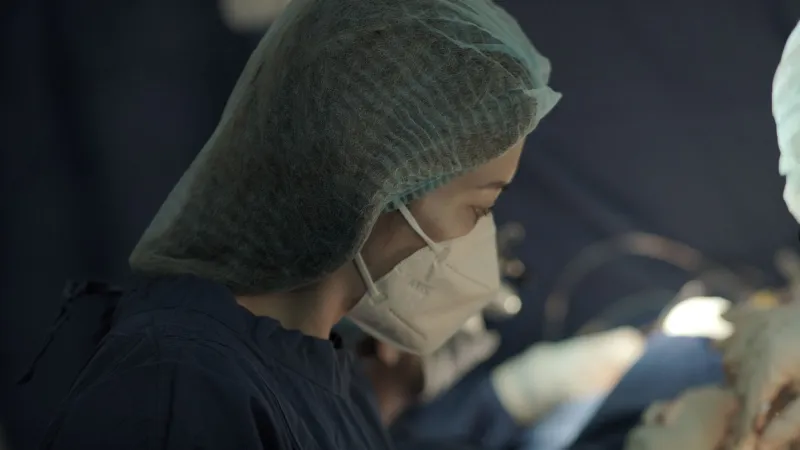
Medical school at UCSF. Residency at Johns Hopkins. A fellowship in neurosurgical oncology — the subspecialty that deals specifically with tumors of the brain and spine — at MD Anderson Cancer Center in Houston. The path reads cleanly on paper. In practice, she was often the only woman in the room, frequently the only Latina, and occasionally the only person who had ever worked a physically punishing job before picking up a scalpel.
That last part, she argues, matters more than people expect.
"Manual labor teaches you something about precision that's hard to learn any other way," she told a medical conference audience in 2019. "You learn how much pressure is too much. You learn that your hands are instruments, not just appendages. And you learn that repetition builds something in you that no classroom can replicate."
What She Built When She Got There
Vásquez is now the director of a neurosurgical oncology program at a major academic medical center in Northern California — the details of her current position vary across sources, and she's generally more interested in talking about her work than her title. What her work involves is operating on high-grade gliomas, the aggressive brain tumors with the statistics that make most people go quiet when they hear them. She has developed a modified resection technique that her team published in 2021, one that has since been adopted in several other programs and is associated with improved outcomes in patients with tumors in previously considered inoperable locations.
But the other part of her work — the part she describes as equally important — is a pipeline program she co-founded called Raíces in Medicine. It identifies first-generation, low-income students in California's agricultural counties and connects them with mentorship, research experience, and application support for health professions programs. Since its launch in 2018, over 140 students have gone through the program. Dozens are now in medical school, nursing programs, or graduate research positions.
"The talent was always there," she says. "It just wasn't being looked for in the right places."
The Photograph
There's a certain kind of success story that gets told in medicine — the brilliant student, the early recognition, the straight line from aptitude to achievement. Vásquez's story isn't that. It's messier, more interrupted, and more dependent on a handful of people who chose to pay attention at the right moment.
What makes it remarkable isn't the distance she traveled. It's what she did with the view from the other side.
The girl in that photograph on her desk still works in the fields of the Central Valley, in a sense. She just works in a different kind of field now — one where the stakes are measured not in bushels but in lives, and where the hands that once carried strawberries now navigate the most delicate terrain in the human body.
She hasn't forgotten where she started. She made sure of it.