He Was Supposed to Be Painting. Instead, He Fixed the Problem That Stumped Materials Engineers for Thirty Years.
The Wrong Classroom, the Right Instinct
Dominic Farrell enrolled in art school because he loved the way things looked. Texture, surface, the way light behaved when it hit a rough edge — these were the things that kept him up at night. Not tensile strength. Not fatigue fractures. Not the long-standing industrial headache of metal-ceramic bonding that had been quietly tormenting aerospace and manufacturing engineers since the 1970s.
But life has a funny way of putting you exactly where you're not supposed to be.
Farrell dropped out of his fine arts program at a mid-sized Midwestern university after two years, not because he failed, but because he ran out of money. He picked up part-time work in the university's materials science department — cleaning equipment, cataloguing samples, doing the invisible labor that keeps research labs functional. He wasn't there to learn. He was there to eat.
What happened next is one of those stories that makes career counselors deeply uncomfortable.
The Problem Nobody Could Crack
For anyone outside the world of industrial engineering, metal-ceramic bonding sounds like a niche concern. It isn't. The inability to reliably fuse metallic and ceramic materials — without the bond degrading under thermal stress — had been a bottleneck in everything from jet engine components to medical implants to next-generation electronics. Engineers had thrown serious money, serious talent, and serious time at the problem. Peer-reviewed journals were littered with partial solutions that didn't quite hold up under real-world conditions.
The core issue was deceptively simple to describe and maddeningly hard to solve: the two materials expand at different rates when heated. Over repeated heating and cooling cycles, that difference creates microscopic stress at the interface. Eventually, the bond fails. Sometimes catastrophically.
The engineering community had approached the problem the way engineers tend to approach problems — systematically, mathematically, and from within a framework of established materials science theory. Which meant they kept arriving at variations of the same answers. Good answers. Just not the right one.
What an Art Student Sees That an Engineer Doesn't
Farrell spent his evenings, after the researchers went home, reading whatever was left open on their desks. Not out of ambition — out of boredom, mostly, and genuine curiosity about what these people were actually doing all day.
What struck him wasn't the chemistry or the physics. It was the geometry.
Years of art training had given Farrell an unusually refined sensitivity to surface structure — specifically, to the way microscopic irregularities in a surface affect how two materials interact. He'd spent semesters studying how paint adhered to different grounds, how ceramic glazes behaved during kiln firing, how ancient craftspeople had solved adhesion problems with nothing but observation and intuition.
Looking at the electron microscopy images pinned to the lab's bulletin board, Farrell noticed something that the engineers had documented but apparently not weighted heavily: the failure points weren't random. They followed a pattern that looked, to his eye, almost identical to the stress fractures he'd studied in medieval pottery glazes.
He mentioned this, almost apologetically, to one of the graduate researchers one morning.
The graduate researcher told him, politely, that it was an interesting observation.
Then went back to work.
The Part Where Nobody Listens
Farrell didn't have the vocabulary to make his case in the language of materials science. He didn't know the right terminology. He couldn't frame his intuition in the theoretical scaffolding the field required. When he tried to articulate what he was seeing, it came out sounding imprecise — because it was imprecise. He was working from pattern recognition, not calculation.
The lab's lead researcher, a well-published engineer with two decades of work in composite materials, was cordial but unconvinced. The idea that a surface micro-texturing approach — borrowed conceptually from ceramic arts traditions — could address a problem that had resisted sophisticated metallurgical intervention struck him as, at best, a creative long shot.
Farrell, undeterred, started running informal tests on his own time. He had access to the equipment after hours. He had enough working knowledge of lab procedure to avoid destroying anything important. And he had, it turned out, enough stubbornness to keep going after the first dozen attempts produced nothing useful.
The Moment It Held
The breakthrough, when it came, was quiet. No dramatic announcement. No eureka moment in the classical sense.
Farrell had been experimenting with a micro-texturing pattern applied to the metallic surface before bonding — a pattern derived almost directly from techniques used in Japanese raku pottery, which he'd studied as an undergraduate. The geometry of the texture created a mechanical interlocking effect at the interface that distributed thermal stress more evenly across the bond rather than concentrating it at weak points.
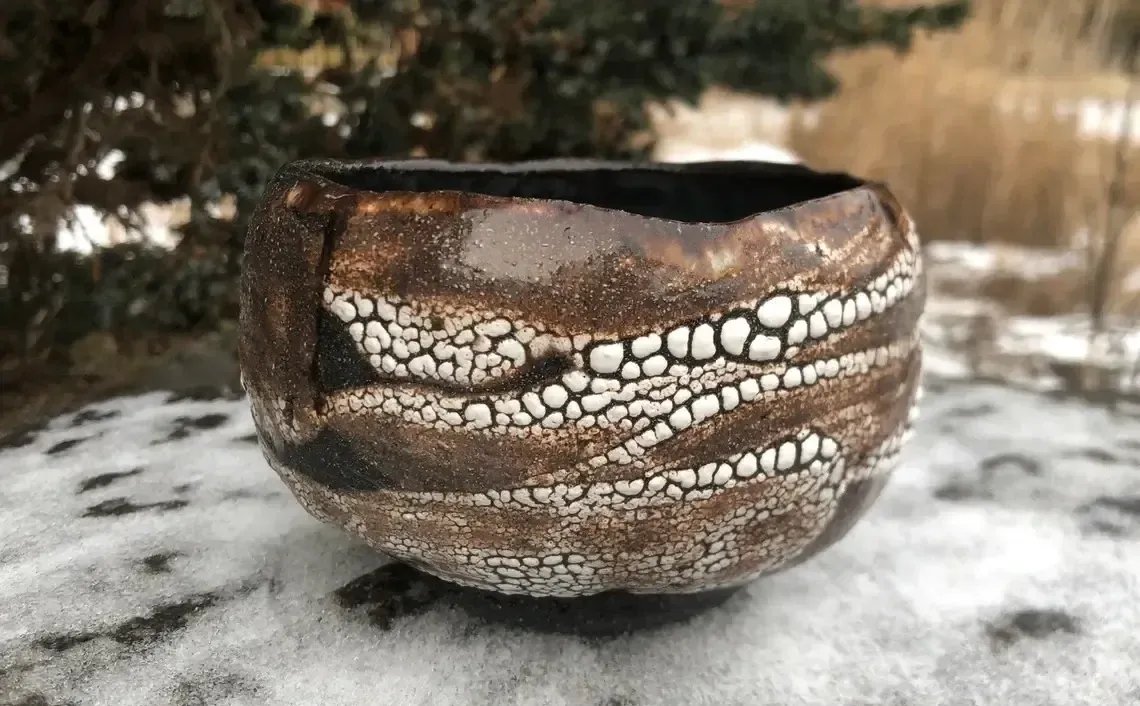 Photo: Japanese raku pottery, via ceramicartis.com
The bond held. Then it held again. Then it held through a thermal cycling test that had broken every previous candidate material the lab had produced.
The lead researcher, to his genuine credit, didn't dismiss it. He ran the numbers. He brought in colleagues. He subjected the approach to the kind of scrutiny that separates a lucky result from an actual solution.
It was an actual solution.
Reluctant Recognition
The paper that eventually emerged from the lab listed Farrell as a contributing researcher — a designation that required some internal debate, given that he held no formal academic position and had never completed a degree. The journal's peer reviewers reportedly found the methodology section unusual. The citations to art history literature were, by all accounts, a first for the publication.
But the results were reproducible. And in science, reproducible results have a way of ending arguments.
Farrell went back to school eventually — not for art, but for materials science. He finished his degree in his late thirties, by which point the technique he'd stumbled onto had already been adopted in several industrial applications and was being studied by research teams who had no idea the original insight came from a college dropout who was supposed to be mopping floors.
What the Experts Missed
The engineers weren't bad at their jobs. That's the part of this story that's easy to misread.
They were very good at their jobs. They just approached the problem from inside a discipline that had its own language, its own frameworks, and its own invisible assumptions about what kind of knowledge was relevant. The art history connection — the ceramic traditions, the surface geometry intuitions — wasn't in that framework. It couldn't be, really. Nobody in the field had reason to go looking there.
Farrell's ignorance of the established approach wasn't a liability. It was, in the most literal sense, his entire advantage. He didn't know what wasn't supposed to work. So he tried it anyway.
That's not a story about genius. It's a story about what happens when someone looks at a familiar problem from a direction nobody thought to look.
Sometimes the solution isn't hiding in a more sophisticated version of the same idea. Sometimes it's sitting in a pottery textbook, waiting for someone with the wrong degree to come along and notice it.