Fermenting in the Dark: How a Hospital Janitor's Kitchen Experiments Put Antibiotic Researchers on Notice
Fermenting in the Dark: How a Hospital Janitor's Kitchen Experiments Put Antibiotic Researchers on Notice
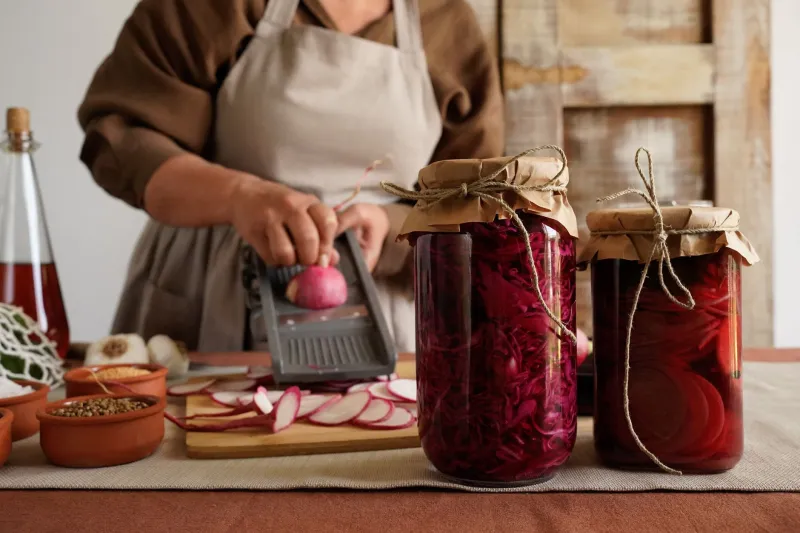
Marcus Webb didn't have a lab. He had a one-bedroom apartment in Cincinnati, a shelf of secondhand microbiology textbooks, and a refrigerator that his girlfriend said smelled like a science project gone wrong. Every morning, after finishing the overnight shift at the hospital where he worked as a custodian, he'd come home and check on his jars.
 Photo: Marcus Webb, via c8.alamy.com
Kombucha. Kimchi. Kefir. Fermented garlic. Lacto-fermented hot sauce. He'd been at it for years — not as a hobby exactly, but as something closer to an obsession. And the obsession had a reason.
The Problem He Saw Every Night
Working the night shift in a hospital puts you in a strange and underappreciated position. You're invisible in the way that service workers often are, which means you're present for conversations, situations, and realities that more credentialed people sometimes miss. Webb had spent six years cleaning rooms, corridors, and surgical prep areas when he started noticing a pattern that disturbed him.
Patients who came in for routine procedures were leaving sicker. Infections that should have responded to standard antibiotics weren't responding. Staff talked in hushed, frustrated tones about resistant strains. Webb wasn't a microbiologist, but he was a person who paid attention — and what he was seeing, night after night, was a quiet crisis that the people in charge seemed to be managing rather than solving.
"I wasn't trying to save anybody," he later told a researcher who documented his story. "I just couldn't stop thinking about it. You watch something not work, over and over, and you start wondering what would."
He started reading. Not academic papers at first — he didn't have easy access to those — but books. Library books. Used copies of microbiology texts. Online forums about fermentation science. He was trying to understand how bacteria worked, how some bacterial communities seemed to suppress others, and whether the ancient human practice of fermentation had ever been studied as a potential source of antimicrobial compounds.
It had. But not nearly enough.
The Jars on the Counter
What Webb began doing in his kitchen wasn't random. It was methodical in the way that only a truly stubborn person can be methodical without formal training. He kept notebooks — spiral-bound, filled with dates, temperatures, ingredient ratios, and observations. He was tracking which fermentation combinations produced cultures that seemed to inhibit the growth of other bacteria on the surface of the jar or in the brine.
He wasn't working with hospital pathogens. He was working with whatever he could legally culture at home, including common molds and bacterial strains found in spoiled food. But he was building a framework — a set of observations about which microbial communities seemed to produce compounds that fought back against bacterial overgrowth.
Over about three years, he narrowed his focus to a specific combination: a lacto-fermented brine involving wild-harvested garlic, a particular strain of naturally occurring lactobacillus, and a secondary fungal culture he'd accidentally introduced through cross-contamination with a sourdough starter. The combination, he noticed, consistently produced a surface film that appeared to suppress bacterial colonies in ways his other experiments didn't.
He wrote it all down. Every batch. Every variable. Every failure.
When the Notebooks Found the Right Reader
The story of how Webb's notes reached a microbiologist at the University of Cincinnati is, depending on who tells it, either lucky or inevitable. A neighbor who worked in the university's administrative offices mentioned Webb's project to a researcher she knew. The researcher, who specialized in novel antimicrobial compounds and was accustomed to dismissing amateur tips, almost didn't follow up.
 Photo: University of Cincinnati, via i.pinimg.com
She did, eventually. And what she found wasn't a breakthrough — not yet. What she found was a set of observations so carefully documented, so methodically recorded, that they were scientifically legible in a way that most amateur work simply isn't. Webb hadn't discovered a cure. But he had identified a microbial combination that, when her lab tested it under controlled conditions, produced measurable inhibitory activity against several bacterial strains — including one that had been proving resistant to multiple antibiotic classes.
The research that followed wasn't fast. Science rarely is. But Webb's original notebooks became part of the documented foundation of a study that was eventually published in a peer-reviewed journal, with Webb credited as a contributing observer. His name appeared in a scientific paper. The janitor's name. In print.
What Proximity Actually Teaches You
There's a version of this story that frames Webb as a savant — a hidden genius who cracked what the experts couldn't. That version is both flattering and wrong. Webb isn't a microbiologist. He made errors in his home experiments that a trained researcher would have caught immediately. His methodology had gaps. His conclusions were sometimes off.
But here's what he had that the researchers didn't: six years of watching antibiotic resistance fail real patients in real time, every night, in the same building. He had urgency. He had proximity to the problem in its most human form. And he had the particular stubbornness of someone who has no professional reputation to protect — someone who can spend three years fermenting garlic in a Cincinnati apartment without worrying about what the department chair thinks.
The microbiologist who eventually worked with him put it plainly: "He wasn't constrained by what we thought was worth looking at. That's not a small thing."
Antibiotic resistance is one of the most serious public health challenges of the 21st century. The pipeline of new antimicrobial compounds has slowed dramatically. And the scientific community, for all its brilliance, has been looking in largely the same places for decades.
Marcus Webb looked in his kitchen. With secondhand books and a spiral notebook and a shelf of mason jars.
The next solution to a problem this big might not come from a lab. It might come from whoever is closest to the problem, paying the most attention, and stubborn enough to keep writing it all down.