No Classroom, No Credentials, No Problem: The Self-Taught Physicist Who Ended Up in the Room Where the Science Happens
The first time a theoretical physicist at a major research university emailed Marcus Hale for help, Hale assumed it was a mistake.
He was sitting in his studio apartment in Albuquerque, New Mexico — the same apartment where he'd spent the better part of four years teaching himself quantum field theory from a combination of library books, MIT OpenCourseWare lectures, and a stack of graduate-level textbooks he'd sourced from used bookstores and library sales. He had no university affiliation. No graduate degree. No undergraduate degree, technically, since he'd left high school in tenth grade. His most recent formal employment had been a warehouse shift supervisor position he'd left to pursue, as he described it to friends at the time, "a thing I need to figure out."
The email was not a mistake.
The Education That Wasn't
Marcus Hale grew up in Albuquerque, the second of three kids in a household that moved frequently and stretched every dollar carefully. School was fine until it wasn't. He was bright — teachers said so, tests confirmed it — but he was also bored in a way that started to curdle into something more disruptive around eighth grade. He wasn't a troublemaker exactly, but he was the kind of student who asked questions that derailed lessons and made teachers feel like they were being audited.
He dropped out at sixteen. Not dramatically — there was no single incident, no blowup, no moment of cinematic defiance. He just stopped going and nobody came looking very hard. He got a GED a year later, more to satisfy his mother than out of any particular ambition. Then he drifted through his late teens and early twenties doing warehouse work, a brief stretch in retail, and a stint driving for a logistics company.
All the while, he was reading.
Not casually. Compulsively. He'd been drawn to physics since stumbling across a copy of Richard Feynman's The Feynman Lectures on Physics at a library sale when he was seventeen — he paid fifty cents for all three volumes — and something in Feynman's voice, that particular combination of rigor and delight, lodged in him like a splinter. He read it cover to cover. Then he read it again. Then he started following the threads it pulled on, working backward through the mathematics he didn't have yet, teaching himself calculus from a textbook he checked out on a three-week loan and renewed four times.
The Apartment and the Whiteboard
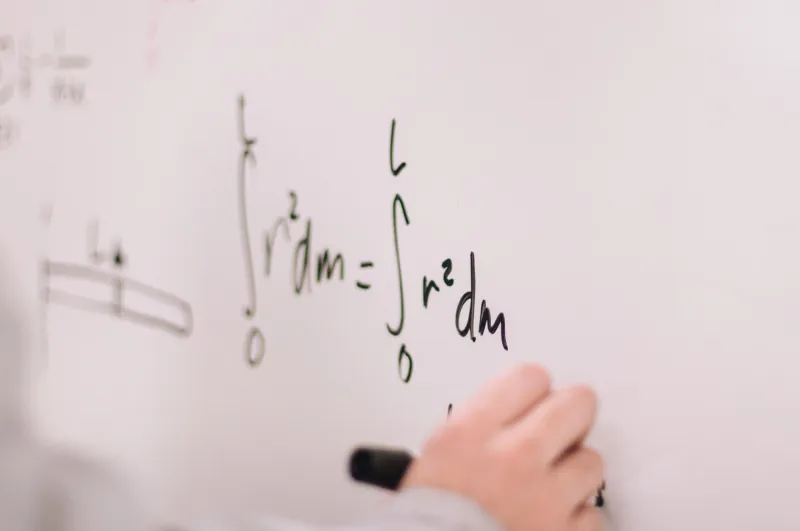
When Hale was twenty-eight, he made a decision that people in his life received with varying degrees of concern. He'd saved enough from his warehouse job to cover about eighteen months of minimal living expenses. He rented the cheapest studio apartment he could find in Albuquerque. He bought a secondhand whiteboard from a Craigslist listing for twelve dollars. And he set himself a goal: he was going to learn quantum mechanics. Properly. From the foundations.
The plan had no endpoint and no external validation. There was no degree he was working toward, no institution he was enrolled in, no professor who knew his name. It was just him, the whiteboard, the Albuquerque public library system, and a growing collection of textbooks he'd accumulated over years.
He started with David Griffiths' Introduction to Quantum Mechanics — the standard undergraduate text — worked through every problem, then moved to Sakurai's graduate-level treatment. He used MIT's openly available course materials to check his understanding against actual syllabi. When he got stuck, he posted questions to physics forums online, often under a pseudonym, and worked through the responses with the same methodical patience he'd developed doing inventory management.
"The warehouse work was actually good training," he's said. "You learn that problems don't care how you feel about them. You just work through them until they're done."
The eighteen months stretched to four years. He picked up part-time work when he needed to. He kept going.
The Forum Post That Changed Things
The pivot point, as Hale tells it, was a post he made on a physics discussion forum in 2019. A thread had opened about a technical problem in quantum chromodynamics — the theory describing how quarks and gluons interact — and Hale, who had by then spent considerable time working through the relevant literature, offered an analysis that ran to several hundred words and included a mathematical approach that nobody else in the thread had suggested.
A physicist at a research university who was lurking in the thread sent him a private message. The conversation that followed lasted several weeks. The physicist — who has since spoken about Hale publicly but prefers not to be identified by name in popular press coverage — was initially skeptical that Hale had no formal training. The work didn't read like someone who was self-taught. It read like someone who had spent years thinking carefully about hard problems.
That physicist introduced Hale to a colleague. That colleague introduced him to another. The network expanded slowly, built entirely on the quality of his thinking rather than the credentials he didn't have.
What He Actually Does
Hale's role defies easy categorization, which is part of what makes it interesting. He's not employed by a university. He doesn't hold a research position. He consults — informally, and in some cases formally — with physicists working on problems in quantum information theory and foundational quantum mechanics, areas where the questions are deep enough and strange enough that unconventional thinking has genuine value.
Several researchers he works with have acknowledged his contributions in published papers. The acknowledgment sections of academic papers are not usually where you find high school dropouts from Albuquerque, but there he is.
He's also become a vocal, if unconventional, presence in discussions about how physics — and science more broadly — identifies and develops talent. His argument is straightforward: the credentialing system is good at finding people who are good at the credentialing system, which is not exactly the same thing as finding people who are good at physics.
"There are people right now sitting in apartments or working jobs they hate who could be doing extraordinary science," he said in a podcast interview that circulated widely in physics and education circles in 2022. "The question isn't whether they're smart enough. The question is whether anyone is looking for them in the right places."
The Limits of the Story
It would be easy to turn Hale's story into a simple argument against formal education, and he's careful not to let that happen. He's said repeatedly that he benefited enormously from the infrastructure that formal education created — the textbooks, the open courseware, the forums staffed by people with PhDs who answered his questions out of generosity. He didn't circumvent the system. He used it from the outside.
What he didn't have was permission. And what his story suggests, uncomfortably for institutions that are built on granting permission, is that permission might matter less than we've decided it does.
The whiteboard in his apartment is still there. It's covered, these days, in notation that would take most people a graduate degree to parse. The radiator still doesn't work right. He's still reading.
Some things, apparently, don't change just because everything else does.