Mapping America in the Dark: The Surveyor Who Couldn't See But Never Got Lost
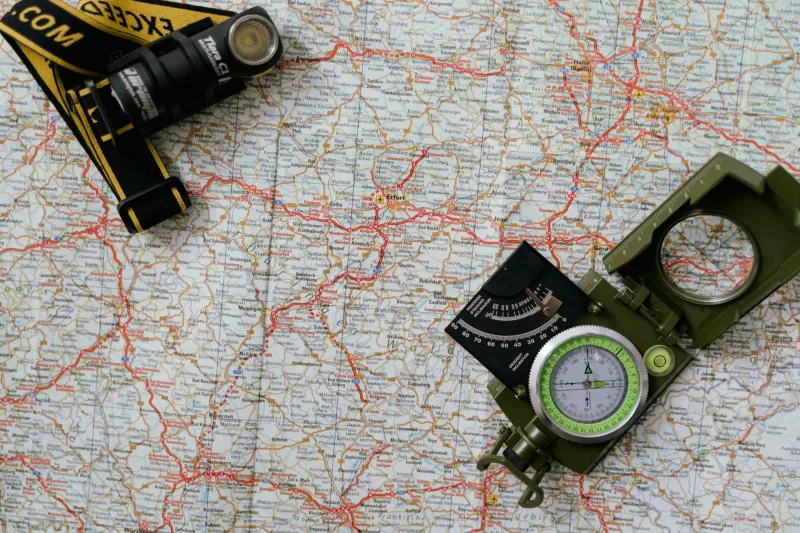
The Man Who Saw With His Hands
In 1847, when James Thompson's eyesight began failing from a childhood injury that had worsened over time, the U.S. Geological Survey politely suggested he find a new line of work. After all, how could a man who could barely make out shapes ten feet away possibly map the vast, uncharted territories of the American West?
 Photo: James Thompson, via i.pinimg.com
Thompson had a different idea. While government surveyors relied on sophisticated instruments and clear sight lines, he developed something far more reliable: an almost supernatural ability to read the land through touch, sound, and spatial memory that defied every convention of 19th-century mapmaking.
What happened next would quietly reshape how America understood its own geography.
Learning the Language of the Land
Born to a farming family in Ohio, Thompson had always possessed an unusual relationship with landscape. Even as a child, he could walk familiar territory blindfolded, navigating by the sound of his footsteps on different soils, the way wind moved through various types of vegetation, and the subtle changes in air temperature that signaled elevation shifts.
When his partial blindness forced him out of conventional surveying, Thompson didn't retreat. Instead, he refined these skills into a mapping methodology that would prove more accurate than anything produced by his sighted colleagues.
His technique was deceptively simple: he would spend days walking a territory, sometimes crawling on hands and knees to feel rock formations and soil composition. He carried a walking stick that he used to probe ground consistency, and he developed an intricate system of knots and notches to record measurements and landmarks.
The Maps That Opened the West
Thompson's first major breakthrough came in 1849, when a group of California-bound settlers hired him to chart a route through the Colorado Rockies after two previous expeditions had failed to find a viable passage. Working alone except for a single guide, Thompson spent three months mapping what would become known as Thompson's Pass—a route that thousands of gold rush emigrants would follow safely to the Pacific Coast.
 Photo: Thompson's Pass, via cdn.wallpapersafari.com
What made his maps extraordinary wasn't just their accuracy, but their practical detail. While traditional surveys focused on broad geographical features, Thompson's charts included information no sighted surveyor thought to record: the acoustic properties of different valleys that could help travelers navigate in fog, the locations of reliable wind patterns that indicated weather changes, and detailed notes about ground conditions that could support heavy wagons.
One settler wrote in his diary: "Thompson's map told us things we never knew we needed to know. When the snow came early and we couldn't see twenty yards ahead, his notes about the sound the wind makes through different canyon formations kept us on the right path when every other landmark had disappeared."
Recognition That Never Came
Despite the proven reliability of his work, Thompson remained an outsider to the official surveying establishment. The U.S. Geological Survey continued to classify his maps as "informal documentation" rather than official surveys, largely because he lacked formal training and couldn't use standard surveying instruments.
This bureaucratic dismissal meant that while Thompson's maps guided some of the most successful westward migrations of the 1850s and 1860s, his name rarely appeared in official records. Settlers and expedition leaders knew to seek out "the blind map man," but government documents credited his work to other surveyors or left it anonymous entirely.
Thompson seemed unbothered by the lack of recognition. In a rare letter that survives from 1863, he wrote to a friend: "The land doesn't care who gets credit for understanding it. The mountains don't read the history books. I know where the safe passages are, and the people who need them find their way to me."
A Different Kind of Precision
Modern GPS analysis of Thompson's surviving maps reveals something remarkable: his hand-drawn charts were often more accurate than official government surveys completed decades later with sophisticated equipment. A 2018 study by the Colorado Historical Society found that Thompson's elevation measurements were typically within 15 feet of modern satellite readings, while contemporary government surveys often had margins of error exceeding 100 feet.
How did he achieve this precision without the ability to see distant landmarks or use optical instruments? Researchers believe Thompson had developed an intuitive understanding of topographic relationships that allowed him to build three-dimensional mental models of vast territories. He could feel the subtle gravitational pulls that indicated nearby mountain masses, hear the acoustic signatures that revealed hidden water sources, and sense the air pressure changes that marked significant elevation shifts.
The Legacy in the Landscape
Thompson continued mapping until his death in 1874, leaving behind a collection of more than 200 hand-drawn charts covering nearly 50,000 square miles of the American West. Many of the routes he pioneered became the foundations for railroad lines and later, interstate highways.
Today, several mountain passes, streams, and geographical features bear his name—though most people who encounter them have no idea they're named for a man who mapped them without ever clearly seeing them.
Perhaps the most fitting tribute to Thompson's legacy is that his maps are still consulted by wilderness guides and backcountry enthusiasts who find his detailed notes about terrain behavior and natural navigation markers more useful than modern topographic surveys. In an age of GPS and satellite imagery, there's something irreplaceable about maps created by someone who understood the land intimately enough to navigate it in complete darkness.
James Thompson proved that the most important tools for understanding geography aren't necessarily the ones you can see—sometimes the most accurate maps come from someone who learned to read the world through every sense except sight.