The Farmhand Who Cracked the Bee Crisis That Stumped the Scientists
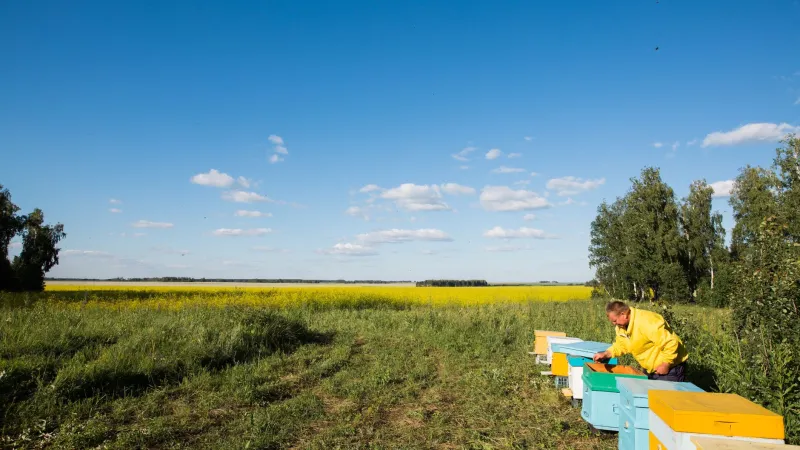
The bees started disappearing in ways that didn't make sense.
Not just dying — disappearing. Hive after hive emptied out, adult bees gone without a trace, leaving behind honey, capped brood, and a queen with no one left to serve. No bodies. No obvious pathogen. No clear explanation. Colony collapse disorder, as it came to be known, was baffling researchers across the country, and the urgency was real: bees pollinate roughly a third of the American food supply, and they were vanishing at rates that had no modern precedent.
Universities launched studies. The USDA funded research programs. Entomologists built climate-controlled observation hives, collected samples, and ran statistical models. For years, the field produced competing theories but no consensus.
Meanwhile, on a working farm in the rural Midwest, a man with no scientific credentials and a spiral-bound notebook had been quietly documenting something that none of the formal studies had managed to capture.
The Education That Happened Outside Any Classroom
He'd worked the land since he was a teenager, the kind of person whose knowledge of agriculture runs so deep it stops feeling like knowledge and starts feeling like instinct. He kept bees not as a hobby exactly, but as a practical part of running a farm — pollinators were a working resource, and he paid attention to them the way he paid attention to everything else that affected his land.
When his hives started collapsing in the mid-2000s, his response was the same as it would have been to any other farm problem: he started writing things down.
Not in any formal way. He wasn't designing a study or following a protocol. He was just recording what he saw — which hives collapsed when, what the surrounding fields looked like, what had been planted nearby, what had been sprayed, what the weather had been, which neighboring farms were affected and which weren't. He cross-referenced his own records with conversations he had with other farmers at feed stores and county fairs. He kept notes on everything, because that's what you do when something on your land isn't working and you're trying to figure out why.
Over the course of nearly a decade, that notebook became something remarkable: a longitudinal record of colony collapse patterns across a real agricultural landscape, documented with the kind of granular, on-the-ground detail that no university study could have replicated.
What the Scientists Missed — and Why
Formal research into colony collapse disorder faced a structural problem that wasn't anyone's fault but was genuinely limiting: it was designed the way science is supposed to be designed, which meant controlling variables, isolating factors, and working with samples that could be observed under consistent conditions.
The trouble is that bees don't live in consistent conditions. They live in landscapes — complex, layered, constantly changing agricultural environments where a dozen different stressors interact simultaneously. The variables formal studies needed to control for were often the exact variables that mattered.
This farmhand had no such constraints. He was observing the whole messy system, not a simplified version of it. And because he'd been watching the same fields for years, he could see patterns that a researcher arriving with a grant and a two-year study window simply couldn't.
What he noticed — and documented, in his unscientific but meticulous way — was a correlation that the laboratory models had struggled to isolate: the timing and proximity of certain pesticide applications, specifically neonicotinoids applied to neighboring crops during specific windows of bee foraging activity, aligned with collapse events in ways that were too consistent to be coincidental.
This wasn't a new hypothesis. Neonicotinoids had been under suspicion for years. But the academic research kept running into the same problem: replicating real-world exposure patterns in controlled settings was extraordinarily difficult, and the results were mixed enough that the connection remained contested.
What this farmhand had was something different. He had years of real-world data from a real agricultural landscape, correlated with real collapse events, documented by someone who had been present for all of it.
The Conversation That Changed Things
The story of how his notebooks made it into the scientific conversation is the kind of thing that doesn't have a clean, dramatic moment — it happened the way a lot of important things happen, through a chance encounter and someone being willing to listen.
A university extension agent working on a regional bee health project stopped by the farm as part of a broader survey. The farmhand showed him the notebooks. The extension agent, to his considerable credit, understood immediately that what he was looking at wasn't amateur speculation — it was a decade of field observation that his own institution couldn't have funded, staffed, or designed.
The data made its way to a research team. The research team spent months working through it, cross-referencing it with their own findings and with agricultural records from the region. What they found confirmed what the notebooks had been pointing to: the correlation between sublethal neonicotinoid exposure during specific seasonal windows and subsequent colony collapse was substantially stronger in the real-world data than anything the controlled studies had captured.
The farmhand wasn't listed as a co-author on the resulting paper. That's a separate conversation about how academic credit works, and it's not a flattering one. But the researchers were generous in their acknowledgments, and within the regional agricultural community, word traveled fast about who had actually cracked the problem.
Proximity as a Research Tool
What this story illustrates isn't that formal science failed — it's that formal science has structural limitations that informal observation sometimes doesn't.
The farmhand's advantage wasn't intelligence or training. It was proximity, patience, and time. He was there every day, watching the same landscape across years and seasons, with no hypothesis to confirm and no grant cycle to satisfy. He was just paying attention.
That kind of sustained, unstructured observation is almost impossible to fund through conventional research channels. It doesn't fit neatly into a methodology section. It can't be peer-reviewed in the traditional sense. But it produces a kind of knowledge that controlled studies genuinely can't replicate — knowledge of how things actually behave in the world, not how they behave when you're watching them carefully under artificial conditions.
The bee crisis didn't get solved in a laboratory. It got solved in a spiral-bound notebook on a working farm, by a man who just couldn't stop paying attention.
Sometimes that's all it takes.