She Couldn't Read a Single Page — So She Remembered Everything Instead
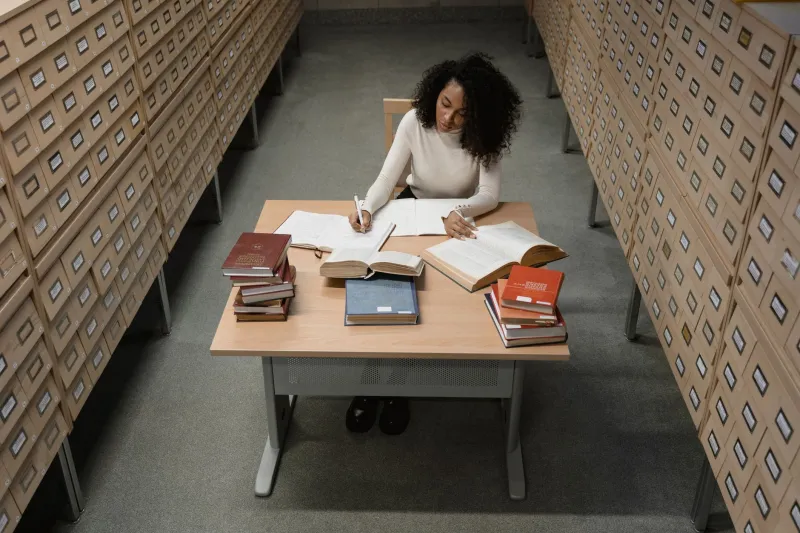
The first time Loretta Vance walked into the Beaumont Public Library, she was twelve years old and completely lost. Not lost in the building — she'd been there a dozen times. Lost in the way that kids with severe, undiagnosed dyslexia are lost: surrounded by walls of information they can't access, watching other people move through words like they're breathing air.
She couldn't tell a B from a D. She couldn't hold a sentence in her head long enough to finish it. Librarians, teachers, and at least one well-meaning aunt had all quietly concluded that books weren't her thing.
What nobody noticed — not yet — was that Loretta was doing something extraordinary every time she came in. She was listening.
The Mind That Wouldn't Quit
Loretta grew up in rural East Texas in the 1950s, the daughter of a mechanic and a seamstress. Dyslexia wasn't a diagnosis anyone in her school district was handing out. You either read or you didn't, and if you didn't, you found another path. For most kids in her situation, that meant dropping out early and finding work.
But Loretta had a stubbornness to her that people who knew her describe as almost cellular. She couldn't read the encyclopedia, so she had the librarian read it to her. When the librarian got tired, she found older students willing to trade reading time for help with chores. She absorbed everything — dates, names, the order of events, the texture of historical moments — and filed it somewhere deep in her memory with a precision that started to unsettle the people around her.
By the time she was fifteen, she could recite the complete entry on the Louisiana Purchase, word for word, from a single listen three years earlier.
Inventing Her Own Method
Loretta never went to college in the traditional sense. She enrolled in a community program in her late twenties, after her kids were in school, and spent two years convincing instructors that her oral exams weren't cheating — they were accommodation. She failed every written test and aced every verbal one. Eventually, a professor named Dr. Harold Simms stopped fighting her and started studying her instead.
What Simms documented was remarkable. Loretta had developed, entirely on her own, a set of mnemonic and associative memory techniques that allowed her to construct detailed internal maps of historical events. She organized information spatially — almost architecturally — assigning places, textures, and emotional tones to facts rather than written symbols. When she recalled something, she wasn't reading it back. She was walking through a room she'd built in her head.
Simms called it "embodied archiving" in the paper he eventually published. Loretta called it "just how I keep things."
The Oral History Revolution
By the time Loretta was hired as a research assistant at a small historical preservation nonprofit in Houston in 1971, she had quietly developed something else: an extraordinary gift for interviewing. Because she had always depended on listening rather than reading, she was exceptionally good at it. She could hold hours of conversation in her head, cross-reference spoken testimony against what she'd memorized, and identify contradictions or overlooked details that written-record-focused historians missed entirely.
This wasn't incidental. It was transformative.
At the time, oral history was considered a secondary methodology — useful for color, not for fact. Loretta didn't think of it that way. She treated firsthand testimony as primary source material and built research frameworks around it that could stand up to academic scrutiny. When she started presenting findings at regional history conferences in the mid-1970s, she drew skepticism at first, then grudging respect, and eventually something close to admiration.
Her 1979 report on undocumented African American land ownership records in Southeast Texas — compiled almost entirely through oral interviews with elderly residents whose families had never appeared in written county records — is still cited in land rights scholarship today.
What the System Missed
There's a particular kind of institutional blindness that Loretta's story exposes. The library system that couldn't reach her as a child, the school that labeled her slow, the academic gatekeepers who nearly turned her away — all of them were optimized for one kind of mind. A mind that processes information through written language, linearly, at a pace set by the text.
Loretta's mind didn't work that way. And rather than being a deficiency, that difference forced her to build tools that the field genuinely needed.
Oral history methodology, now a cornerstone of archival science and community preservation work, owes a significant — if rarely credited — debt to researchers like Loretta who came up outside the written-word pipeline. The Oral History Association, founded in 1966, was gaining momentum during exactly the years Loretta was developing her methods independently. She wasn't alone in seeing the value of spoken testimony. But she was among the first to treat it not as a workaround but as a discipline.
The Library She Built
In 1983, Loretta became the director of community archives at a regional history center in East Texas — the same county where she'd grown up unable to read the library's spines. She held the position for over two decades.
Under her leadership, the center built one of the most extensive oral history collections in the Gulf Coast region. She trained dozens of researchers in interview methodology and pushed the institution to accept audio and video recordings as primary archival materials at a time when many institutions still resisted the idea.
She also, quietly and without fanfare, learned to read. Not fluently — she'll tell you that herself. But enough. Enough to sign her own reports. Enough to read her grandchildren a story at bedtime.
"I didn't need reading the way people thought I did," she said in a 2001 interview. "I needed history. Those are different things."
What Her Story Tells Us
Loretta Vance's career is a case study in what happens when a system fails to accommodate a mind and that mind decides to build its own architecture anyway. She didn't succeed despite her dyslexia. In a very real sense, she succeeded because of what it demanded of her — the workarounds, the listening, the memory, the relentless search for another way in.
The irony is almost too neat: the woman who couldn't read a page ended up teaching institutions how to preserve the stories that never made it onto one.
Some of the most important records in American history were never written down. Loretta understood that before most of the field caught up. And she understood it because she had no other choice.