The Lunch Break Draftsman: How an Unschooled Laborer Drew the Blueprint That Stumped Engineers Couldn't
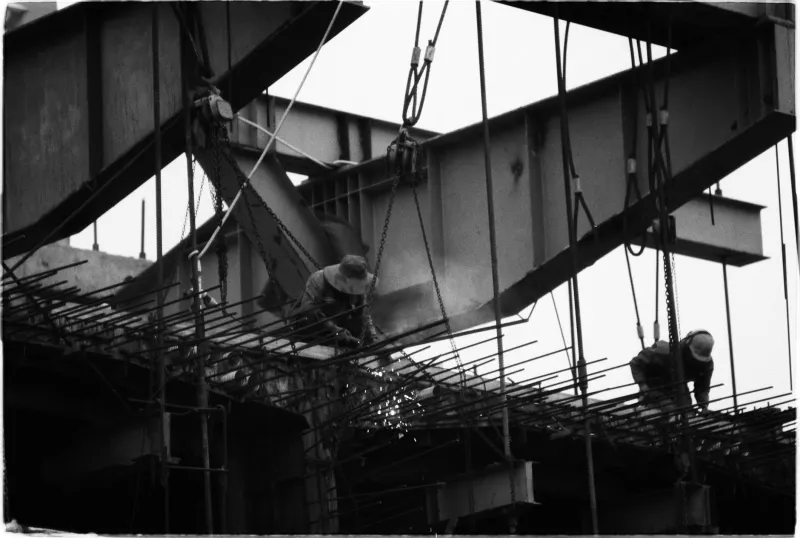
The Lunch Break Draftsman: How an Unschooled Laborer Drew the Blueprint That Stumped Engineers Couldn't
He didn't have a drafting table. He had a plank of scrap wood, a worn-down pencil, and exactly forty-five minutes between the noon whistle and the one that sent him back to work.
For most of the men on that construction site, lunch was coffee, cards, and complaints about the foreman. For Elias Pruett, it was something closer to obsession. Every day, he unfolded the same grease-stained notebook, stared at the half-built bridge skeleton rising over the river, and went back to work on a problem that the engineers upstairs had been fighting for the better part of a year.
 Photo: Elias Pruett, via dbukjj6eu5tsf.cloudfront.net
Pruett was a site laborer. No degree. No professional license. No seat at the table where decisions got made. He hauled materials, cleared debris, and stayed invisible in the way that working men of his era were expected to. What nobody knew — what he barely admitted to himself — was that he had spent the previous decade quietly teaching himself structural mechanics from library books and discarded technical manuals.
A Problem Nobody Could Solve
The bridge in question was a mid-span suspension project proposed for a river crossing in the industrial Midwest during the early 1930s. The engineering firm contracted to design it had run into a stubborn complication: the riverbed's geology on the eastern bank was far softer than initial surveys had suggested, which meant the original anchor system couldn't bear the load calculations they'd already committed to. Redesigning the anchor from scratch would blow the budget. Sticking with the original plan risked catastrophic failure. The project had stalled for months.
Pruett heard the foremen arguing about it. He watched the engineers come and go from the site office with the defeated look of men who'd exhausted their best ideas. And every lunch break, he kept sketching.
His solution was elegant in the way that only genuinely intuitive engineering tends to be — not flashy, not radical, just quietly correct. Rather than fighting the soft geology, he proposed distributing the anchor load across a wider footprint using a splayed cable configuration that redirected lateral tension downward at a shallower angle. It reduced the stress on any single point in the ground without requiring a complete redesign of the tower structure. He'd worked it out using load tables he'd memorized from a textbook he'd checked out of the public library so many times the librarian had started setting it aside for him.
The Moment He Decided to Speak
For weeks, he said nothing. Men like Pruett didn't walk into the site office and tell engineers they'd gotten it wrong. That wasn't how the world worked, and he knew it.
What changed things, according to accounts pieced together decades later, was a conversation he overheard between two junior engineers who were openly discussing scrapping the project entirely. To Pruett, abandoning the bridge meant abandoning the jobs — including his own — and abandoning the community that had been counting on the crossing for years. So he did something that took more nerve than any structural calculation: he folded up his notebook, walked to the site office, and knocked on the door.
The reception was not warm. The lead engineer on the project reportedly told him to go back to work. One of the junior men laughed. But Pruett left the notebook on the desk and walked out.
Two days later, a different engineer — a younger man named Thomas Hale who'd joined the firm only recently — picked it up.
 Photo: Thomas Hale, via data.shorthand.com
What Hale Found
Hale later described the notebook as "startlingly precise for something written on brown paper with a carpenter's pencil." The load calculations weren't formatted the way an engineering school would have taught, but the underlying logic was sound. More than sound — it was the answer they'd been circling for months without landing on.
Hale brought it to the senior team. The debate that followed was, by some accounts, heated. There was real resistance to the idea that a laborer had solved what credentialed professionals hadn't. Some argued the solution was obvious and they'd have reached it themselves. Others quietly recognized that they hadn't, and that the notebook in front of them represented something they didn't quite have a framework for.
The design was incorporated into the final plans. Pruett's name did not appear in any official documentation.
Erased, Then Rediscovered
For decades, the story lived only in fragments — a mention in Hale's private correspondence, a few lines in a local newspaper profile of the bridge's completion, a note in the county historical society's files that referred to "an unnamed site worker" whose suggestion had influenced the anchor design.
It wasn't until a historian researching labor history in the construction trades began cross-referencing site payroll records with engineering firm archives in the 1980s that the pieces started connecting. Pruett had died years earlier, but his daughter confirmed the story. She still had a second notebook — one he'd kept at home — filled with the same calculations, dated months before the bridge's revised design was filed.
The historian's paper, published in a small academic journal, didn't exactly shake the world. But it found its way to people who cared about it. Engineers who read it. Educators who started using it in courses about institutional bias in technical fields. A small plaque was eventually installed near the bridge's eastern anchor — not at the center of the span where the official commemoration sits, but off to the side, easy to miss if you're not looking for it.
What the Bridge Actually Proves
There's a version of this story where Pruett's talent is the whole point — where we celebrate the self-taught genius and move on. But that version lets the system off too easily.
Pruett wasn't exceptional because he taught himself structural mechanics from library books. Plenty of people have done that. He was exceptional because he did it in a world that gave him every reason not to bother — no reward, no recognition, no pathway from what he knew to what he was allowed to do with it. The gatekeeping wasn't incidental. It was structural, built into the same institutions that were supposed to be finding the best solutions.
The bridge still stands. If you cross it, you probably don't think about the man who saved it on his lunch break with a pencil and a borrowed idea about load distribution. But the load is still being carried, quietly, by a design that came from someone nobody thought to ask.
That's usually how it works.